


The short answer: Local SEO starts with four basics: your customers’ search terms, a separate page for every important service, clear information about your location and service area, and regular tracking, for example with Google Search Console.
No one can seriously guarantee a particular ranking. Good basics do, however, improve the conditions for being found.
What is local SEO?
Many searches have a local connection. Sometimes it’s right in the search, such as “hairdresser Schwabing” or “electrician Munich”. Often, though, Google shows nearby results even without a location, because a local intent is likely.
Local SEO covers all measures that help your business be understood and found better in such searches. Two areas are particularly important: your website and your Google Business Profile, which appears in Google Maps, for example. This article focuses on the website.
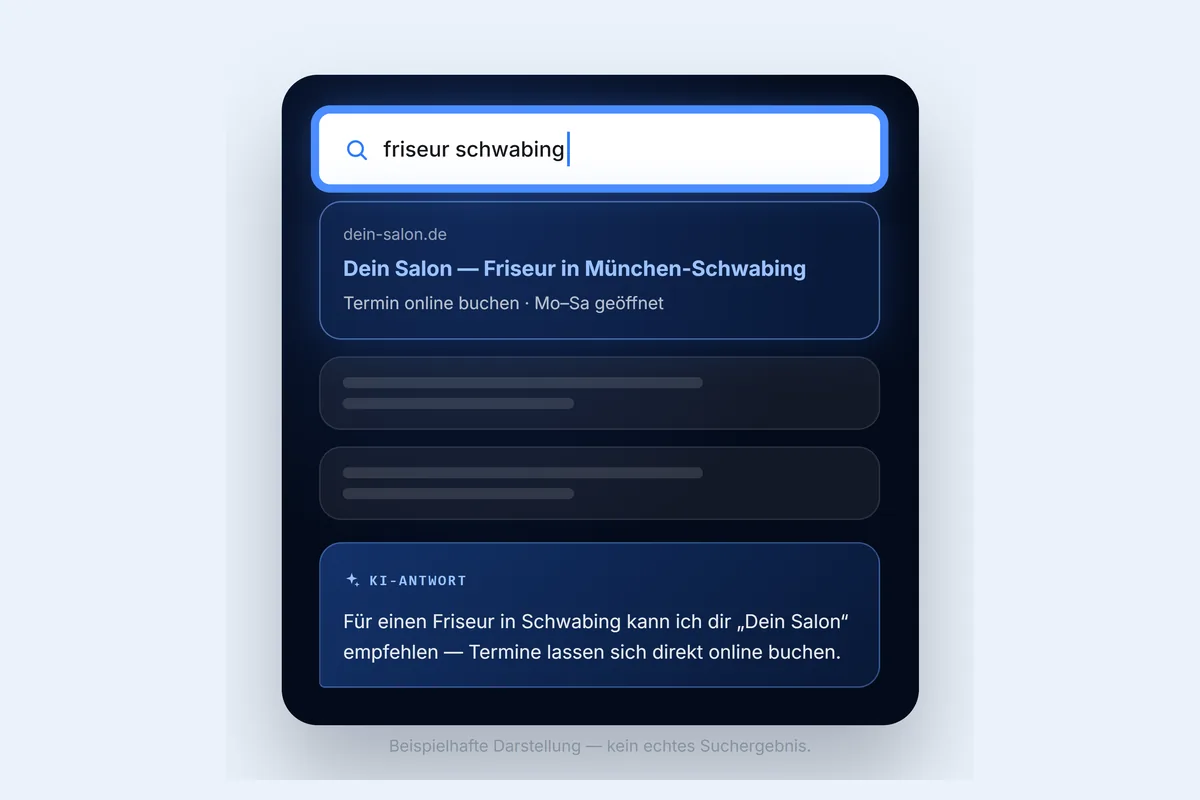
Step 1: Finding the right search terms
It starts with the question of what your customers actually search for. Think from their point of view: Which words do they use, which problems do they want to solve, and which places do they mention?
| Industry | Possible search terms |
|---|---|
| Hairdresser | friseur schwabing, damenhaarschnitt münchen, strähnen färben münchen |
| Painting company | maler münchen, fassade streichen münchen, malerbetrieb in der nähe |
| Physiotherapy | physiotherapie münchen, krankengymnastik termin, manuelle therapie |
Helpful free sources are Google’s suggestions as you type, the “Related searches” section and – once your website is live – the data from Google Search Console. The questions customers ask you on the phone are also valuable clues.
Step 2: Matching pages for every service
A single page can’t be the best answer for all search terms at once. So create separate pages for your most important services. Each page should:
- have a unique page title with the service and location
- carry a main heading that clearly names the topic
- contain a meta description that invites clicks
- answer the most important questions about the service specifically
- link to other relevant pages and to contact
Many almost identical pages where only the place name is swapped offer visitors no added value. Google explicitly lists such pages as an example of doorway abuse in its spam policies. Separate pages for individual places are only worthwhile if they have genuinely distinct content.
Step 3: State local information clearly
For search engines to associate your business with a place, clear information is needed:
- name, address and phone number, written the same everywhere
- your service area, for example districts or a radius
- opening or office hours
- structured data according to Schema.org, which lets search engines read details such as address and opening hours in a machine-readable way
A well-maintained Google Business Profile is also worthwhile. It’s free and appears in Google Maps, among other places. Make sure the details there match your website.
A Business Profile requires that you serve customers in person, for example at your premises or at the customer’s location. Businesses that operate purely online are not eligible. Google describes the exact eligibility requirements.
Step 4: Technical basics
The best content helps little if search engines can’t capture it. The technical basics include:
- The pages may be indexed by search engines.
- A sitemap lists all important pages.
- The website works flawlessly on smartphones.
- The pages load quickly.
- The website is encrypted via HTTPS.
- Headings are structured logically.
The free website check covers many of these points, including page title, meta description, headings, canonical link, robots.txt and sitemap.
Step 5: Measuring success
With the free Google Search Console, you can see which searches your website appears for, how often it’s clicked and whether Google has problems indexing your pages.
| Metric | What it shows |
|---|---|
| Impressions | how often your website appeared in search results |
| Clicks | how often users clicked on your website |
| Queries | which terms your website was shown for |
| Average position | where your pages ranked on average |
Assess the development over weeks and months, not individual days. A simple additional approach: ask new customers how they found you.
SEO and AI assistants
AI assistants such as ChatGPT can also use websites as a source of information. Clear content helps: understandable descriptions of your services, specific answers to customer questions and publicly accessible business information. Whether and how a system mentions your business, however, is up to that system. A mention cannot be guaranteed.
Common local SEO mistakes
- All services are only on the home page.
- The location only appears in the legal notice or the footer.
- All pages have the same page title.
- Important text is shown as an image instead of text.
- District pages consist of copied text.
- Contact details differ between the website and the business profile.
How I support you
Technical SEO fundamentals are part of every website I build. For existing websites, I offer further support: I review content, page structure and technology, propose specific measures with priorities and implement the agreed changes. We agree on scope and costs in advance. Learn more on the SEO for businesses in Munich page.